
The short version
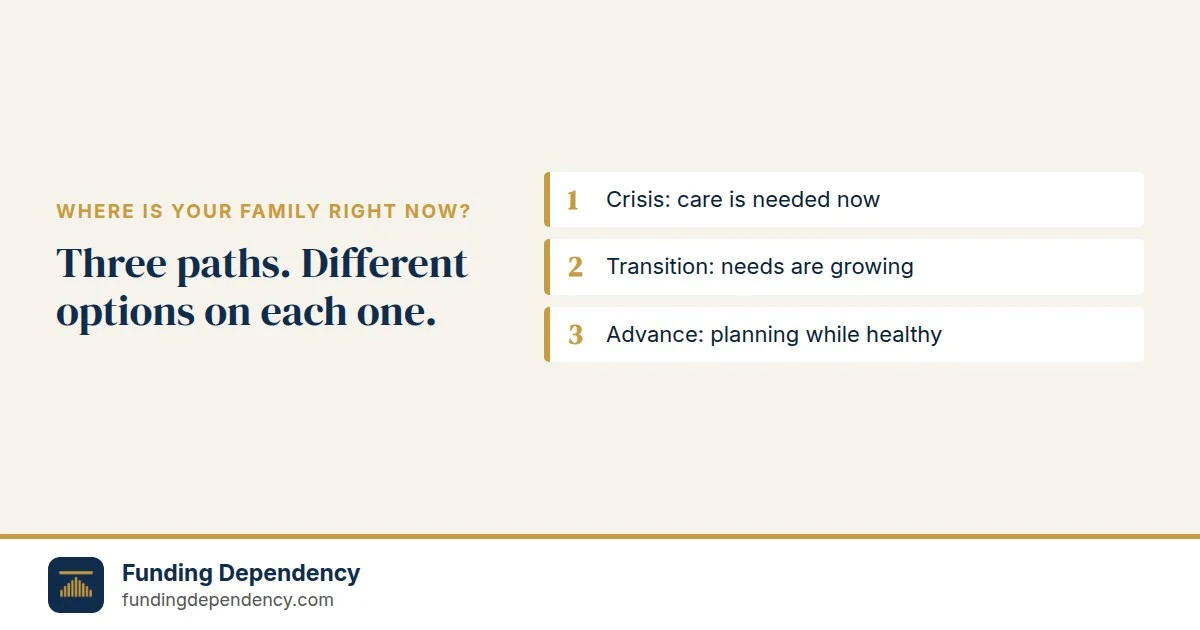
- Crisis path: care is needed now. Options are narrower but still real.
- Transition path: needs are growing. This is often the most valuable window to plan.
- Advance path: everyone is healthy. Insurance and five-year Medicaid planning are still possible.
- Medicaid reviews 60 months of transfers, which is why timing matters so much (CMS).
Two families with the same savings can end up with very different outcomes. The difference usually isn’t money. It’s timing: how much runway they had when they started planning.
Why timing matters more than assets
Several of the ten funding pillars only work if they’re set up in advance. Long-term care insurance requires you to qualify medically. Advance Medicaid planning needs five years for the look-back to run (CMS). Once a diagnosis or a crisis arrives, those doors start to close, and the options that remain are different.
That’s why Funding Dependency organizes families into three paths.
The crisis path: care is needed now
What it looks like: a hospital discharge is being planned, a facility is being considered, or home care has started and costs are mounting.
What still works:
- Medicare for a short skilled nursing stay after a qualifying hospital admission
- Crisis Medicaid planning with an elder law attorney, which can still protect part of the savings
- VA Aid and Attendance for eligible veterans and surviving spouses
- Private pay and the home as a bridge
First step: see an elder law attorney quickly. Every month of private payment reduces what can be protected. Our crisis path page lists what still works.
The transition path: needs are growing
What it looks like: memory changes, a recent fall or a new diagnosis. A parent needs more help every month, and the family can see where it’s heading.
Why it’s valuable: there’s still time to put legal documents in place, line up benefits and choose care settings deliberately. Some insurance options may still be open depending on health, and VA and Medicaid strategies can be prepared before they’re needed.
First step: confirm a durable power of attorney and health care surrogate are signed, then map the pillars. Our transition path page explains the steps in order.
The advance path: everyone is healthy
What it looks like: no one needs care yet, and you want a plan before you need one.
What’s still possible: everything, including traditional long-term care insurance, hybrid life/LTC and advance Medicaid planning with enough time for the five-year look-back.
First step: see our advance path page, and consider applying for coverage while you’re healthy.
The odds make this worth doing
Someone turning 65 today has almost a 70% chance of needing some type of long-term care (LongTermCare.gov). Most families will travel at least one of these paths. Starting on the advance path keeps the most options open.
Find your path
Our free Journey Assessment asks twelve questions about health, timing, assets and family, then ranks the pillars that fit.
Educational content only. Not legal, financial or medical advice.
Common questions
What are the three long-term care planning paths?
Crisis, when care is needed now; transition, when needs are growing but not yet urgent; and advance, when everyone is healthy and planning ahead.
Is it too late to plan once care is needed?
No. Options are narrower, but Medicare, crisis Medicaid planning, VA benefits, private pay and the home can still be combined. See an elder law attorney quickly.
Why does timing matter for Medicaid planning?
Medicaid reviews gifts and transfers made in the 60 months before an application. Advance planning needs that time to run; crisis planning uses different tools.