
The short version
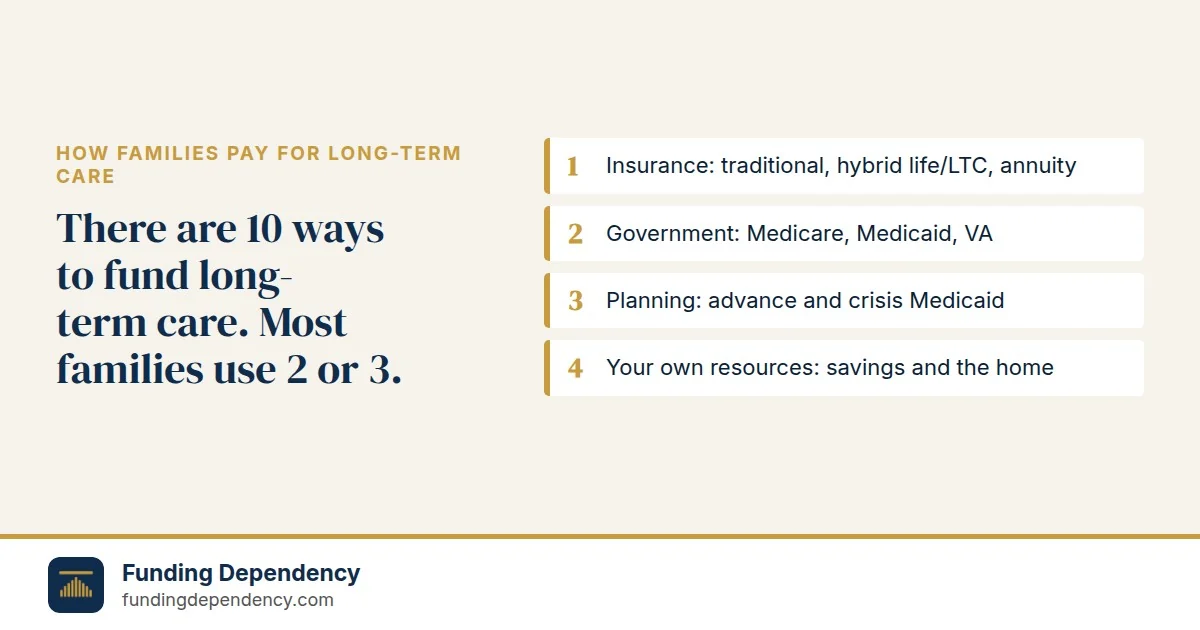
- There are ten ways to fund long-term care, not two. Most families combine two or three.
- Three insurance pillars must be set up in advance, while you’re healthy enough to qualify.
- Medicare covers only short skilled stays, not ongoing custodial care (Medicare.gov).
- Which pillars are open depends mostly on timing: before care is needed, as needs grow, or in a crisis.
Ask most people how long-term care gets paid for and you’ll hear two answers: your own savings, or Medicaid once the savings are gone. Both are real, but they are only two of ten options, and families who know all ten usually keep more choices and more of their savings.
The ten funding pillars
Funding Dependency groups every realistic way to pay for care into ten pillars. Here they are in plain terms:
- Traditional long-term care insurance: a stand-alone policy that pays a daily or monthly benefit once you need help with daily activities.
- Hybrid life/LTC: permanent life insurance with a long-term care benefit. It pays for care, or a death benefit if care is never needed.
- LTC annuity: a deferred annuity paired with long-term care benefits, often funded from savings you already have.
- Medicare: short skilled nursing and rehab stays after a qualifying hospital admission.
- Medicaid: the largest payer of long-term care, with state asset and income rules (Medicaid.gov).
- Advance Medicaid planning: legal strategies set up years before care, so the 60-month look-back has time to run.
- Crisis planning: options when care is needed now.
- VA Aid & Attendance: a pension supplement for eligible wartime veterans and surviving spouses who need help (VA.gov).
- Private pay: savings, income and investments.
- The home: equity from a sale, a reverse mortgage or other strategies.
Why "savings or Medicaid" falls short
Thinking only in terms of savings or Medicaid leads to one common plan: spend down until you qualify. That can work, but it tends to happen in a hurry, with fewer choices about where care happens and less protection for a spouse at home. The Administration for Community Living notes that most people pay for care through a mix of sources. Many families also assume Medicare will help more than it does. Medicare.gov is clear that Medicare doesn’t pay for most long-term custodial care, which is help with bathing, dressing and other daily activities.
Timing decides which pillars are open
The most useful way to read the list is by timing:
- Before care is needed: the three insurance pillars and advance Medicaid planning. Insurance is medically underwritten, so it has to be bought while you’re healthy enough to qualify.
- As needs grow: private pay, the home and VA benefits often carry a family through the middle years, and planning around Medicaid rules still has value.
- When care is needed now: Medicare for a short skilled stay, crisis planning and Medicaid.
Our three planning paths walk through each situation in more detail.
How families combine pillars
Most families end up using two or three pillars together. A couple in their late 50s might pair a hybrid policy with savings. A widow with a paid-off home might plan to use home equity first and Medicaid later. A veteran’s family might combine Aid and Attendance with private pay for assisted living. Our article on how families combine the 10 funding pillars shows real-world combinations.
Where to start
You don’t need to understand all ten pillars in depth. You need to know which two or three fit your situation, and what deadlines apply to each. The free Journey Assessment ranks the pillars for your circumstances in about four minutes.
Common questions
What are the main ways to pay for long-term care?
There are ten: traditional long-term care insurance, hybrid life/LTC, LTC annuities, Medicare for short skilled stays, Medicaid, advance Medicaid planning, crisis planning, VA Aid and Attendance, private pay and home equity. Most families combine two or three.
Does Medicare pay for long-term care?
Not for most of it. Medicare covers short skilled nursing or rehab stays after a qualifying hospital admission. It doesn’t pay for ongoing custodial care, which is help with daily activities such as bathing and dressing.
When should I start planning to pay for long-term care?
Ideally before you need care. The insurance pillars are medically underwritten, and advance Medicaid planning needs time for the look-back period to run, so starting earlier keeps more options open.