
The short version
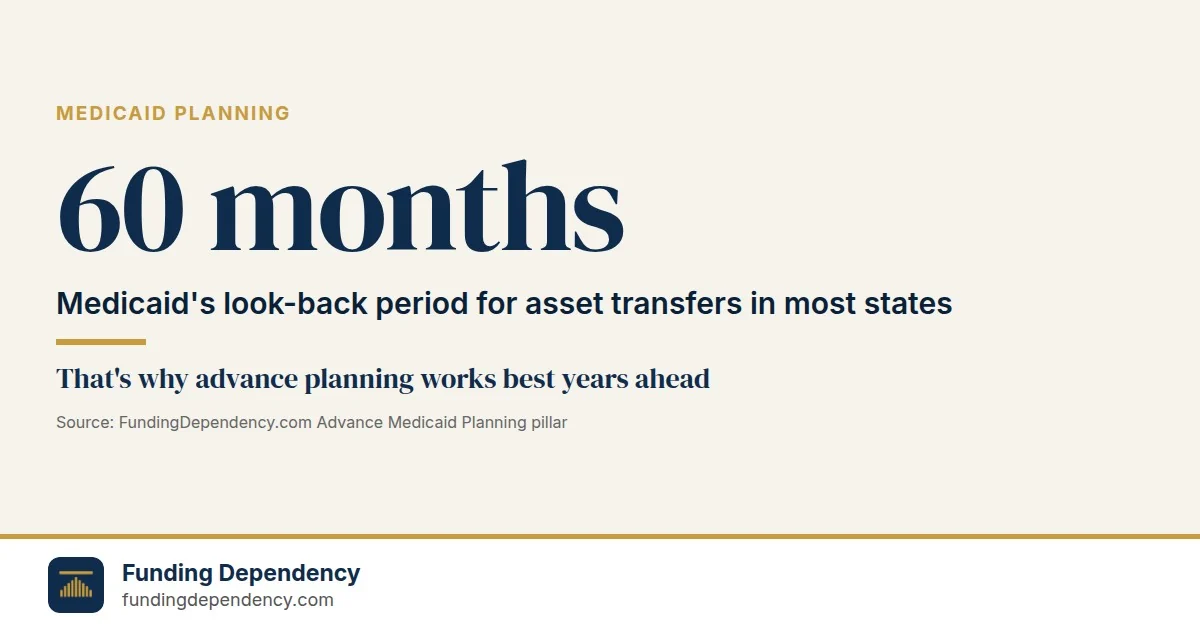
- Medicaid reviews gifts and transfers made in the 60 months before a long-term care application (CMS).
- The penalty equals the amount transferred divided by the state’s average monthly nursing home cost.
- The penalty clock starts only once the applicant is in care and otherwise eligible, not on the gift date.
- The IRS annual gift exclusion doesn’t protect a gift from the look-back.
Most Medicaid penalties don’t come from elaborate schemes. They come from ordinary family generosity: a check to a grandchild, help with a down payment, or putting a child’s name on the deed. Here are the five mistakes we see most.
How the look-back works
When someone applies for nursing home Medicaid or most home and community-based waivers, the state reviews five years, 60 months, of financial records (CMS). The rule comes from Section 1917 of the Social Security Act (SSA). It’s looking for transfers for less than fair market value: gifts, below-market sales and unexplained withdrawals.
Any such transfer triggers a penalty period, months when Medicaid won’t pay for care. The state divides the amount transferred by its average monthly private-pay nursing home cost. And critically, the penalty doesn’t start when the gift was made. It starts once the applicant is in a nursing home and would otherwise qualify. That’s what makes these penalties so painful: the money is gone, and the care bill is due.
Mistake 1: assuming small gifts don’t count
Birthday checks, help with a grandchild’s tuition, paying a child’s rent. All of these can count. There is no minimum in federal law, though some states disregard very small amounts.
Mistake 2: relying on the IRS gift exclusion
The IRS annual gift tax exclusion is a tax rule. It has nothing to do with Medicaid. A gift can be completely fine for tax purposes and still cause a Medicaid penalty.
Mistake 3: adding a child to the deed
Putting a child’s name on the house is often meant as a simple estate plan. For Medicaid, it can be a transfer of part of the home’s value, and it exposes the home to the child’s creditors or divorce. Florida and a few other states allow a Lady Bird deed, which works very differently.
Mistake 4: paying family caregivers without a contract
Paying a daughter for the care she provides can be legitimate. Without a written caregiver agreement, signed in advance and at a fair rate, Medicaid may treat those payments as gifts.
Mistake 5: poor records
The state will ask about large withdrawals and transfers. Cash withdrawals with no receipts, or payments to family with no explanation, can be presumed to be gifts. Keep statements and receipts for five years.
How families avoid penalties
- Plan early. Advance Medicaid planning, usually with an irrevocable trust, works best when there are more than five years of runway.
- Know the exempt transfers. Transfers to a spouse, and in some cases to a disabled child or a caregiver child who lived in the home, are exempt. An attorney can confirm what applies.
- Spend on exempt items. Paying off debt, home repairs, a replacement vehicle and prepaid funeral costs lower countable assets without a penalty, depending on the state.
- If you’re inside the window, crisis planning tools may still help, and some transfers can be cured by returning the asset.
See an elder law attorney licensed in your state before making gifts if long-term care may be needed within five years.
Educational content only. Not legal, financial or medical advice.
Common questions
How long is the Medicaid look-back period?
60 months, or five years, before the Medicaid long-term care application, in nearly every state.
How is a Medicaid penalty period calculated?
The state divides the amount transferred by its average monthly private-pay nursing home cost. The result is the number of months Medicaid won’t pay.
When does a Medicaid penalty period start?
Not on the date of the gift. It starts once the applicant is in a nursing home and would otherwise qualify for Medicaid.
Does the IRS gift tax exclusion protect gifts from Medicaid?
No. The annual gift exclusion is a tax rule. Any gift within the 60-month look-back can still cause a Medicaid penalty.